International Adoption from Serbia–Good News for Adoptees
I knew adoption was uncommon in Serbia, but I had no idea how uncommon.
The puritanical perception of the “sin” of unprotected sex and the resulting stigma of an unplanned pregnancy … Weeellll, that’s not really a “thing” here, as far as I’ve observed. There’s plenty of stuff to be ashamed of; giving birth to a healthy baby is not one of them. Truly, children are cherished in Serbia.
Adoption Policies: What Serbia is Doing Right
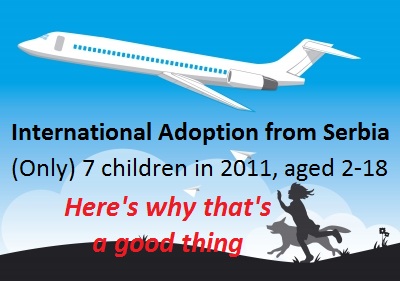
By the numbers. The U.S. adopted children from Serbia:
- 7 (only seven!)–in 2011
- 12–in 2010
- 4–in 2009
In 2010 and 2011, Serbia issued international adoptions to the U.S. only, no other country.
Serbia places great emphasis on domestic adoption, requiring children to be available for domestic adoption for one year, before being adopted internationally. Basically: No infants can be adopted internationally, only children aged two-eighteen.
Currently, there are about 500 families waiting to adopt infants domestically. Why is this a good thing? Domestic adoption helps to keep intact a child’s language, ethnicity, and connection to his first family and culture.
In practice, Serbia only allows children with special needs–physical or mental–to be adopted internationally.
What about money?! How much does adoption cost in Serbia?
More good news: Serbia has drastically limited the ability for people to profit from adoption.
There are no Serbian government fees for adoption and all paperwork is completed by the Center of Social Work. (No comment on my experience with the snail-like, convoluted nature of Serbian bureaucracy in general.)
It costs approx. $25 for the issuance of the child’s Serbian passport.
There are no adoption agencies in Serbia. The government is trying to crack down on bribery which is, honestly, alive-and-well in other institutions.
Fees do add up though, for travel expenses and document translation. A U.S. Visa and U.S. Passport for the child can cost several hundreds of dollars, but that’s on the American side, not Serbian.
Protection of Child Privacy
During the adoption process, the identity of the child is kept secret. Photo listings online of children is illegal. Upon adoption, the new parents are provided with complete social and medical histories of the child, along with the real names of the biological parents.
Super-interesting note directly from the U.S. State Department on Serbia adoption:
Caution: Prospective adoptive parents should be aware that not all children in orphanages or children’s homes are adoptable. In many countries, birth parents place their child(ren) temporarily in an orphanage or children’s home due to financial or other hardship, with the intention of returning for the child when they are able to do so. In such cases, the birth parent(s) rarely would have relinquished their parental rights or consented to their child(ren)’s adoption.
Additional guidelines (which may or may not be so great)
Marriage: Parents must be married (common law is accepted). Single parents can receive special permission. No comment.
Parents’ age: At least 18, but no more than, 45 years older than the child. Not to old; not too young, that’s good. Parents who have been diagnosed with mental illness or an infectious disease are disqualified. Okay, not crazy, not infectious; plusses for a kid getting new parents.
Same sex couples are not permitted. I’m not sure why, but I can take a wild guess as to why, based on the general Balkan homophobic outlook.
Caveats … Oh Laura, enough with those pesky caveats
I just know I am going to get “slammed” in the comments section if I don’t make these notes about “concerns for another day” …
- What about the Roma (gypsies), and their negative perception in Serbia? Are they adoptable, or classified as disabled in some way?
- What about the dire state of orphanages?
- How do you know just how mentally or physically disabled a child is?
- What about the fact that Serbia is not a Hague country when it comes to adoption? (This is partly because of the sorry state of those orphanages. They’re working on it, but Serbia is still a poor country. Yes folks, it’s yet another post for another day.)
If you want to read further:
Image from freedigitialphotos.net



I'm happy to hear about the low numbers in Serbia. I didn't quite understand the part about leaving your child in an orphanage if you have financial problems and then "getting him/her back" later.
Thanks, Sonia — it's a temporary measure. People are poor here, especially outside of Belgrade. If you have one income earner, and he looses his job, and you don't have extended family to fall back on … there is nothing. There are no IRAs, credit card, if you don't have cash, you can't buy food. It's just reality, and so people have to let their child live at an orphanage so they can get back on their feet. Or, in war, if the husband dies and then mom gets sick and can't care for her children … that type of thing. Very sad.
Laura
Laura,
What if one of the parents is a Serbian citizen? My husband was born in Serbia and is a US resident. I am a US citizen. Would different rules apply?
Isnt it better than parents who kill there child because they couldn't afford them
Laura: This information is so helpful. Thank you for your honest and thought-provoking posts. Your posts about the Serbian culture are funny and spot-on. I have a few questions about Serbian adoption that are more relevant to an American with direct connections to Serbia than an average American seeking adoption. I wonder whether you would be willing to contact me directly. Thanks again.
It is a one of the great article which is very useful to me as well. I am sure the article must useful to me as well. because the article most useful to me as well. Thanks a lot mate.
this post is good for news, thank you for this information.
I am Australian, and my mum was born in Novi Sad I am looking to adopt in the next 4-5 years but it's a shame I can't from Serbia.
Hi there. I just stumbled upon your blog. I have adopted four children from Serbia. All of them have Down syndrome. ONLY children with special needs are able to be adopted from Serbia. Being Roma is not considered a special need. Even healthy Roma babies are being adopted. Serbia only adopts to three countries, USA, Sweden (or is it Swizerland? I forget now! I can verify) and France.
Serbia became part of the Hague agreement effective April 1st, 2014. US agencies must apply to the Serbian adoption authorities to be approved to operate in Serbia. You can contact the Serbian adoption authorities to get a list of approved US agencies. Unfortunately, because Hague is now involved, the cost to US families has gone up dramatically. I completed my last adoption just two weeks before the law change went into effect. I GET the reasons for Hague, and am generally in support of it. However, Serbia has been running a clean program for several years (beginning in 2010 when a corrupt facilitator was outed and since removed) and was following Hague guidelines prior to the official change. That means this new process hasn't changed AT ALL on the Serbian side. What has changed on the US side is a couple of additional forms and more money into the hands of US federal agencies. And yet, "its all about the kids." This is very frustrating to me, as the additional $10K people are spending in the US due to the Hague process would have gotten another Serbian child into a family.
The other good thing about adopting from Serbia is you can ask questions about the child you are being potentially matched with. However, it IS international adoption, which means you need to be prepared to get a child home who has something you didn't expect, or is even better off than what you expected. Serbia is an amazing country, and I have found the adoption authorities there very pleasant to deal with. Also, when you get in country and meet your child for the first time, you are given several opportunities to turn down the child's referral.
Oh, and I adopted in 2010, 2011, 2013 and 2014.
Hello,
I am French and does not speak very good English, I want to adopt in Serbia and we discussions between our two ministries.
We have not much information about the children they are offered a share has specific needs but we have no details on specificitées, apart from the down syndrome, autism or other.
Y is there other specificity as epathite, heart disease or even the age of the child.
thank you
There are a variety of options available for when you need to make an international call. Knowing how to save money on your calls to other countries can leave you with more money to have fun.
If you want to improve your know-how only keep visiting this web site and be updated with the most recent

news posted here.
Russel recently posted..Russel
Russel recently posted..Russel
Hi to every one, it’s truly a good for me to visit this web page,

it contains useful Information.
avocat indivision recently posted..avocat indivision
avocat indivision recently posted..avocat indivision
hi! I stumbled upon this blog while searching for information on my missing relative. If you have or are going to adopt a child from Serbia, please double-check the documents because Serbia is notorious for selling kidnapped babies for adoption. Doctors and social services are involved and this has been going on since the 70's. Here are a few links: http://falanga.com.au/en/frightening–in-serbia-1…
One more: http://www.balkaninsight.com/en/article/parents-o…
Wrong, wrong, and more wrong, I was born in Montenegro Former Yu in the 80's and while I lived there for 18 years not a single living child/baby I have ever heard of have disappeared from our regions (Little and big towns surrounding Kotor and near towns), and news travel so fast over-there.. so please check your facts with some people that actually lived there during 70's 80's and 90's. I can't clearly comment about war affected areas as I never lived there but… please don't refer us to some random website and claim that is the truth, my blood boils to read nonsense comments from random people like you.
I am from the USA and very close wkth a Serbian boy who attends the university here. His mom died a few years ago so I have been a mom to in in every way . We discussed adoption and so I am trying to see if I can in fact adopt him. He will be 21 years old in a few months . In the USA you can adopt at any age but anything I am reading on Serbian sdoption does not reflect the same. Does anyone have any insight on that?
I am very thankful to this topic because it really gives up to date information.
Hi, You shared very outstanding information with us keep sharing more article like this. poor orphanage in chennai